
Has AI hype reached its peak?
AI hype is peaking. Dr Rumman Chowdhury explains why use cases remain limited, AGI definitions are shifting, and investors are starting to question the narrative.
Read More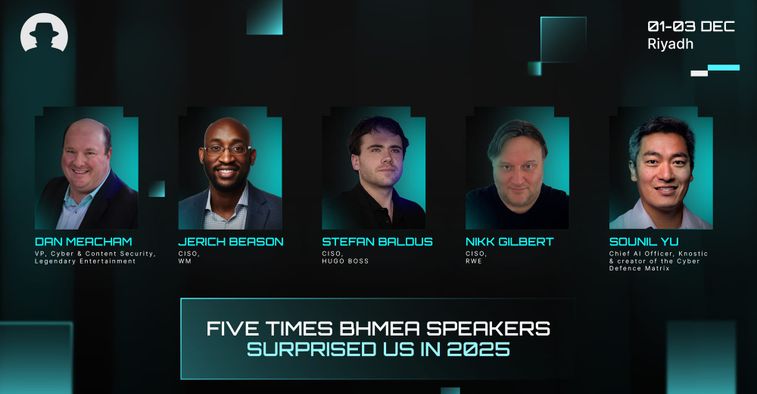
Anyone who thinks cybersecurity is boring has never been to Black Hat MEA. And honestly, we don’t even think that’s a bold claim; it’s just the truth. Here on the blog we’re in conversation with BHMEA speakers all the time, and 2025 has been no different.
From Hollywood sets to railway lines and boardrooms, our speakers kept challenging our assumptions this year.
So here are five moments that made us stop and think again.
When we talked to Dan Meacham (VP, Cyber and Content Security at Legendary Entertainment), we expected stories about script leaks and piracy. What we didn’t expect was his way of reframing the credits crawl as an attack surface.
“Look at the credits crawl at the end of a movie, there are literally thousands of names and many different companies in the list. Every one of those names touched the production in some fashion. And each name on that list is a potential cyber threat.”
If we needed a reminder that in any complex ecosystem, every single contributor becomes part of your risk model…this was it.
Read Dan’s full interview here.
Plenty of security leaders talk about business alignment. Jerich Beason (CISO at WM) went further – sharing a moment that most CISOs will recognise, but few actually admit publicly.
“I had presented a technically flawless case for a security investment, but I walked out of the room with no buy-in. I realised that I had won the argument but lost the room. That was humbling.”
For lack of a better word: oof. That’s the kind of sentence you feel in your stomach.
It also kills the myth that flawless technical reasoning is enough. In 2025’s boardrooms, influence, timing, and psychological safety matter just as much as the content of the slide deck.
Read Jerich’s full interview here.
You’d expect a long-serving CISO at a global fashion brand to talk about brand protection, retail fraud, maybe supply-chain attacks. Stefan Baldus (CISO at HUGO BOSS) surprised us with something sharper.
“Many years back I think security was easier. Not so many actors (good and bad), not so many different threats. Sometimes I think there are as many security tools and companies out there as there are threat actors; but in the end all the tools won’t save you.”
In a year where the focus on platform consolidation has grown, that’s a useful cold splash of water. Tools are important, of course they are; but without processes, culture and realistic expectations, they’re set dressing.
Read Stefan’s full interview here.
We also asked Nikk Gilbert (CISO at RWE) what blind spot we’ll look back on in ten years and say: we can’t believe we missed that. His answer zoomed out far beyond any single control or tool.
“Continuity. We assume the digital fabric of our world, including the cloud, satellites, undersea cables, and GPS, will always be there. But it is not a law of nature; it is fragile. A rupture in that fabric, from something like conflict, sabotage, or natural catastrophe, could unravel more than we imagine. The blind spot will be a lack of humility; in believing our systems were permanent.”
In a year when everyone was talking about AI, this was a jolt back to fundamentals: availability, physical fragility, and the systems we assume will never fail.
Read Nikk’s full interview here.
Finally, Sounil Yu (Chief AI Officer at Knostic and creator of the Cyber Defence Matrix) reflected on something that will resonate with anyone who’s ever over-engineered a framework.
“I used to be more rigid in my thinking around how the Cyber Defense Matrix should be interpreted and used. But I realised that I was making it more complex than it needed to be. I would tell my past self that clarity is more valuable than complexity. The most enduring impact comes from making the complex understandable without losing the essence of helping people make better informed decisions based on what the Cyber Defense Matrix shows.”
In a discipline that loves nuance, edge cases, and ‘it depends’, this focus on clarity feels like a manifesto for the next phase of cyber. We’re aiming for less theatre, and more usable thinking.
Read Sounil’s full interview here.
We can use these comments to guide us as we head into 2026. Here are the lessons.
Write them down, save them in your Notes app, come back to them when you need. Because to get ahead of cyber threats over the coming months we’ll need sharper ways of thinking about people, time, and the systems we depend on.
Join the newsletter to receive the latest updates in your inbox.
AI hype is peaking. Dr Rumman Chowdhury explains why use cases remain limited, AGI definitions are shifting, and investors are starting to question the narrative.
Read More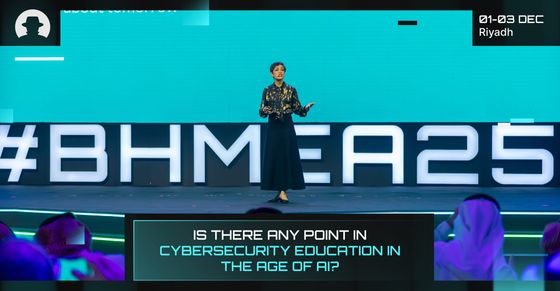
Is cybersecurity education still relevant in the age of AI? Dr Rumman Chowdhury explores how AI is reshaping learning, expertise, and the skills security professionals need.
Read More
Ransomware is evolving beyond encryption. 2026 threat reports reveal the rise of data-leak extortion, pre-encryption exfiltration and a growing ecosystem of cybercriminal groups targeting sensitive data.
Read More