
From access to impact: why 2025 was the year OT threats grew teeth
OT cybersecurity took a hit in 2025 as threat groups mapped control loops and targeted distributed energy – shrinking the gap between access and physical impact.
Read More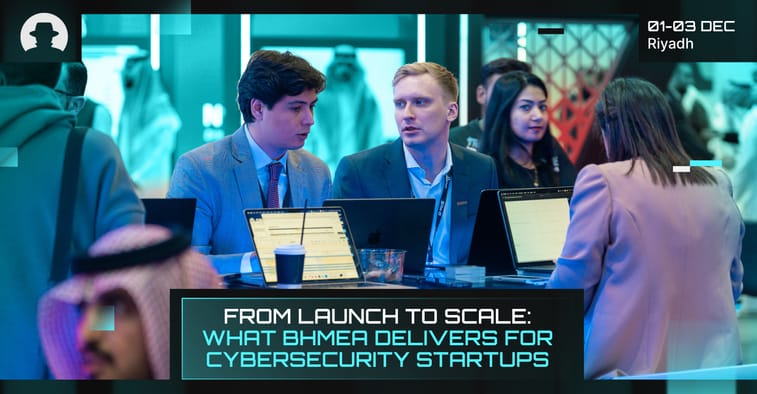
Choosing where to show up as a cybersecurity startup is critical. Trade shows are expensive and time-consuming, and they’re noisy – as a founder, it’s hard to capture the attention of the right people, so you can make your investment in an event worthwhile.
That’s exactly why founders keep coming back to Black Hat MEA. Because here, they get validation, access, and real momentum.
Ahmed Sharif (Co-founder of Fortivera) knows the difference. He’s been attending Black Hat for years, but 2025 marked a shift.
“I’ve been an active participant of Black Hat for the last five years… it’s the first time exhibiting with my startup company.”
This time, Sharif wasn’t there to observe. Fortivera was soft-launching a new product – an AI-powered mobile application security tool designed to scan vulnerabilities and align with regional compliance requirements.
For startups, that kind of launch needs pressure-testing. Black Hat MEA provides it in real time.
Alexandre Salameh (Business Developer at Oxyhack) summed up the value of the event simply: “the connections”.
Black Hat MEA offers “big visibility”, he added – and crucially, visibility “with our target audience”.
Oxyhack operates across penetration testing, training, and capture-the-flag competitions, spanning technical teams and senior leadership. For Salameh, Black Hat MEA brings that full spectrum into one space, making conversations more meaningful and more efficient.
For founders, those conversations can have a more significant impact than polished demos.
Vinodh Kumar Balaraman (Founder and CEO of CyberCheck360) came with a clear view of why the event matters. “Black Hat is the biggest event bringing all the security practitioners,” he said, from analysts and engineers through to CISOs. “I could never miss it.”
CyberCheck360’s product brings “the email security gateway and user awareness together into the mailbox”, helping users make better decisions before they click.
At Black Hat MEA, that idea was tested. As a startup, Balaraman saw people stopping by, asking questions, and trying to understand the product. At the same time, he noticed investors and potential partners offering “useful feedback we can take away with us”.
For early-stage companies, that kind of feedback loop is difficult to manufacture elsewhere.
The event also forces startups to confront regional realities head-on.
Ammar Alsiyabi (Co-Founder and CEO of NeoSec AI) framed the problem his company is tackling bluntly. In the GCC, he said, “88% of all ransomware attacks happen… because of leaked credentials”.
The issue isn’t always technical complexity. “It’s not patch management, it’s not a vulnerability, it’s not a misconfigured firewall,” Alsiyabi said. “If your password is leaked… your security doesn't work anymore.”
For startups like NeoSec AI, Black Hat MEA becomes a live environment to test whether that focus resonates with buyers facing those exact threats.
For others, the value lies in scale.
Yisrael Gross (Chief Business Officer at Ammune.AI) described 2025 as a step forward. After attending the year before through a partner, the company decided it was time to stand on its own.
“This is the first year we’re presenting in a booth,” Gross said, calling Black Hat MEA “a very friendly startup-oriented exhibition”.
The decision was tied directly to growth. While Ammune.AI already has an office in Dubai, Gross explained that the company wants to expand beyond the UAE. “The biggest event is Black Hat MEA,” he said, because it brings “customers from all around the region”.
At the event, he met people from countries where Ammune.AI has no offices, no representatives, and no existing footprint – the kind of reach that would otherwise require significant time and cost.
Founders bring their businesses at different stages (launching, validating, scaling), and many return year after year.
The reasons are consistent. Black Hat MEA gives startups a place to be seen by the right people, to have real conversations, and to test whether their ideas hold up outside pitch decks.
For cybersecurity startups trying to grow in a crowded (and sceptical) market, that combination is critical.
Join the newsletter to receive the latest updates in your inbox.
OT cybersecurity took a hit in 2025 as threat groups mapped control loops and targeted distributed energy – shrinking the gap between access and physical impact.
Read More
Ransomware now reaches full encryption in just three hours. Analysis of Barracuda and Securin data reveals how Akira and others are accelerating attacks.
Read More
The average time to exploit has fallen from 745 days in 2020 to just 44 days in 2025, according to Flashpoint. Here’s why N-day vulnerabilities are driving faster attacks.
Read More