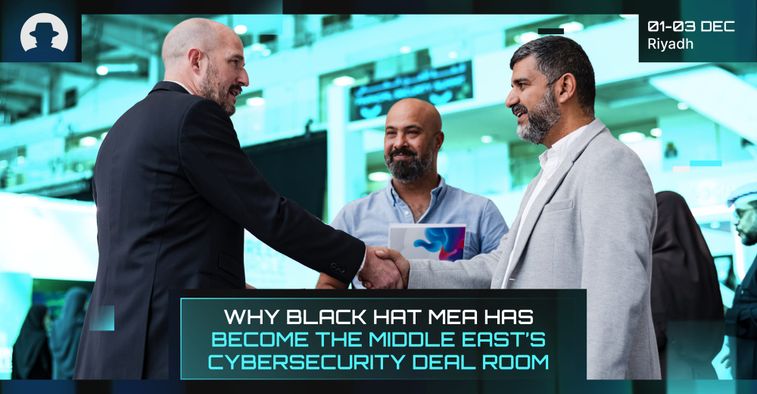
Cybersecurity conferences are part theatre, part networking exercise. But at Black Hat MEA we take the conference format, crumple it up, and smooth it out again in a new way – to drive more tangible outcomes for every exhibitor and investor in the room.
Walking around the exhibition floor in 2025, we heard serious conversations about regional growth, distribution partnerships, and long-term market positioning in the Middle East. Because as countries in the GCC continue to accelerate digital transformation programmes, cybersecurity spending and vendor activity have expanded alongside them.
And Black Hat MEA is at the centre of that commercial ecosystem.
Some firms now consider attendance to be essential. Julian Richard (Co-founder and CTO at Filigran) recently opened operations in the region, and told us:
“With Filigran and Black Hat, we started three years ago. We do Black Hat Las Vegas, we do Black Hat Asia, and now we are here. It’s really the conference we cannot miss.”
For many vendors entering the Middle East, BHMEA has become part of the infrastructure of doing cybersecurity business here.
Partnerships are driving expansion
One of the clearest themes across all our interviews with startup founders at BHMEA 2025 was the importance of partnerships.
International cybersecurity firms looking to scale in the Gulf still rely heavily on distributors, systems integrators and resellers to navigate local procurement cycles and market dynamics. Events like this compress months of introductions and meetings into a single week.
Richard described the event as a rare opportunity for relationship-building in a highly globalised industry:
“It’s always a good moment to meet partners and create strong relationships. Now with a global company like Filigran, you don’t really have time to meet physically with people and create really good relationships – so this is the right moment to meet the partners and sign agreements and discuss the future.”
That emphasis on face-to-face engagement came up again and again. Abdelilah Takhrifa (Regional Director for Aikido Security Middle East) said the event had been recommended to the company specifically because of the concentration of regional stakeholders gathered in one place.
“Black Hat was recommended to us by many people as it's the one place where the entire Middle East comes together to learn about new products, new companies and innovations in the security space.”
For Aikido Security (which provides code security, cloud security, and runtime security) the event also served as a way to evaluate potential channel partners.
“Black Hat has a lot of different partners here. There are distributors, there are system integrators, there are re-sellers,” Takhrifa said. “What we have taken away from our attendance here is that it’s ideal for us to find a partner that fits the same pace that Aikido has.”
That point is particularly relevant in the Middle East market, where growth often depends on finding partners with the right customer relationships and delivery capabilities. The strength of your product alone isn’t enough.
Takhrifa added:
“Having that variety here makes it much easier to understand who we should partner with and who to wait for in the longer term.”
For regional firms already operating across the GCC, Black Hat MEA is also becoming a visible indicator of how quickly the market is expanding.
Mohamed Sameh (Cyber Security Director at Fixed Solutions) said his company has exhibited at BHMEA for the last three years, and he’s noticed how the event has grown each time.
Fixed Solutions offers services including red teaming, penetration testing, SOC services and GRC services, while also developing its own cybersecurity products, including GRCeek and BAGIRA. According to Sameh, BHMEA now functions as both a technical exchange and a commercial platform.
“We have a chance to exchange information, discover new trends, and of course make new business opportunities by signing MoUs and contracts with other vendors.”
He also directly linked the growth of cybersecurity demand to Saudi Arabia’s ongoing digital transformation push:
“In Saudi Arabia, digital transformation is going through major changes across all the entities. All the government services are offered through digital channels now.”
Inevitably, this expansion creates new security pressures for both public and private sector organisations – and as a result Black Hat MEA is both a place to build resilience through knowledge exchange, and a place to access the opportunities that arise from those pressures.
The region’s cybersecurity market is maturing fast
We’ve never been focused on scale at Black Hat MEA – the size of the event is one outcome of the value it provides. We’re more interested in the role it plays in the region’s cybersecurity economy.
The conversations happening on the exhibition floor increasingly revolve around regional expansion plans and localisation strategies, along with long-term investment in the market.
For startups entering the region, the event offers concentrated access to partners, resellers and customers. For regional players, it provides visibility into emerging trends and business opportunities. And for the wider industry, it has become a reflection of just how quickly cybersecurity in the Middle East is evolving.
Black Hat MEA is the place to turn ambition into signed deals. We can’t wait to see you in Riyadh for the 2026 edition.